Christian Mental Health Therapy and Medication Are Not Weak Faith or Sinful Issues — Getting Help Without Shame
A Christ-centered approach that embraces therapy and medication without shame.
It’s not a sign of weak faith; it’s actually a sign of having wise faith and can lead to “in Christ” spiritual growth.
Let’s gain a clear and practical understanding (8 min. read):
What if “it” wasn’t weak faith, but actually wise and strengthening faith?
It’s not perfect, but learning from bad experiences with professional care
Scripture shows God’s heart for professional (spiritual) care
Why Christians should consider professional intervention — practical insights
It’s not a sin or weak faith to live with mental health challenges; it’s an opportunity for growth … where God Himself is.
What if therapy and medication actually refreshed, renewed, and made our faith more resilient — would you inquire for more help?
What if therapy and medication got you untangled, unstuck, and brought mental and emotional (even physical) relief to navigate (and engage) with life in better ways, causing spiritual growth — would you inquire for more help?
In my opinion, Christians should consider mental health therapy and medications if and when needed because it's not only wise, it’s Scriptural — and it can be part of the faith journey, not a lack of faith or sin. Many psychologists agree spirituality should be part of care because research (e.g., neurotheology) shows that it often speeds recovery, builds resilience, and brings more meaning to life.
Let’s first address the elephant in the room - where professional intervention didn’t work, but made it worse.
Therapy and medication are not perfect. There is no perfect therapist, coach, or medication.
I know personally (family) and other stories where many get stuck with the unhelpful therapy and medications, which made things worse. From my own lived experience, despite praying through the process, it seemed that my family’s situation led to more unhelpful professional interventions (trust me, I’ve got some interesting stories, too). Unfortunate as it was, I will say that it didn’t lead me to discount therapy or medications; it led me to learn and see a broader, more educated approach.
NOTE: It’s the same issue with pastoral ministry, where their pastoral care can go from bad to worse (there’s research on this; it’s another topic to give them grace and forgiveness, too). Despite their mistakes, it doesn’t discount ministry or ministers; it’s about educating them to be skilled in broader ministry approaches (I have provided many trainings for clergy and lay ministry leaders).
The issue is about learning, not discounting professional intervention. Remember, it’s not perfect, but we can go in to explore the intervention with healthy feedback loops to figure out what’s working and not — they want to know, too.
I’ve coached/consulted many who felt stuck, learned how to have constructive feedback conversations with their professionals, and things dramatically improved. Notice how a lot of professionals will take the same position to learn what works for you by saying, “Let’s try this (medication, therapy approach),” because they don’t want to see you get “stuck” or worse, either. Again, we just have to set up better communication (feedback loops) to tell them what works and what doesn’t — especially in therapy (where many clients feel bad/guilty to say something, or feel like something is wrong with them if they disagree with their counselor or therapist — but you can, and it can lead to more constructive insights and even better intervention).
Before we get into the therapy and medication practicals, let’s briefly explore God’s heart on Christian’s receiveing mental health therapy and medication.
1. God Reveals His Heart for The Weak.
In Luke 11:30-37, after Jesus affirmed “Love God and love your neighbor as yourself,” a legal, theological expert wanted to justify (boast or flaunt) his own righteousness (his life all “obediently” put together) by asking, “Who is my neighbor?”
Jesus shares the story of the Good Samaritan to specifically and radically define loving our neighbor as first the “weak” and how we need to respond to their felt and pain-point needs (which includes rescuing, therapeutic healing, and restorative care). Jesus radically redefines who our neighbors are, first as the “weak” and our immediate concern should be to rescue, resource, and restore — Jesus even included our neighbor as those whom we see as our enemy (Matthew 5:37-48).
God longs to be with His children in all their "weakness.” Distance is a foreign concept to Him, and loving our “neighbor” removes all misconceptions (and transforms us in the process).
This Good Samaritan story has a double meaning.
First, God is Christlike, and Jesus is Godlike! Jesus is what God the Father looks like in response to go (come to us), rescue, restore, and care for His hurting children, especially the “weak” — as He personally identifies Himself with them (Isaiah 61:1-4; Matthew 11:28-30, Matthew 25:37-40; John 9:1-3).
Second, we are to “Go and do the same” for our “neighbor” (Luke 11:37, Romans 15:1-3; Philippians 2:34). As the Good Samaritan story points out, “medicinal” agents and care were administered (i.e., bandages, oil, and wine — which have both spiritual and natural healing connotations).
2. Why Christians should consider professional therapy (to unravel and get unstuck so you can flourish).
There are many things about therapy and coaching, but basically, the goal is to help you both unravel the knot and get unstuck from the constant ruminating thoughts, panic-fears, mood instability, and what’s decreasing in life, work, school, relationships, etc., so you can discover your unique and flourishing, resilient life.
Yes, (for the pros reading this) I know this, above and bullet points below, are oversimplified, but at least a simple starting point for many.
Unravel the knot. To untangle the complexity of your challenges (thoughts, perceptions, etc.) into a cohesive way to make sense of them and grow through and from them (as I like to say, “work down —> work through”).
Get Unstuck. To get unstuck by discovering and utilizing various resiliency growth tools to work down, and work through the challenges (stressors). These tools can incorporate both natural stress inoculations and mental practices that incorporate a benevolent, loving God, empowering you in each step through the process. We incorporate many of the basics of these tools within our workbooks (Living Grace and more in-depth in Thrive; not professional therapeutic - basic concepts for anyone and support the Pro tools).
Experience Unique Growth: Interestingly enough, various studies reveal that, even though we can get stuck in suffering and struggle (mental health challenges), it can be a gateway to deeper personal and spiritual growth and transformation (see Rom. 5:1-5).
“Renewing Minds”: Many times, as you unravel the knot and get unstuck with new tools, this can often lead to the unhelpful and false spiritual narratives about God and ourselves. A great therapist/coach can empower and help you discover healthy spiritual truths and narratives that naturally lead to spiritual growth. This growth overlaps with your overall resilience. Various studies have shown that people with healthy views, beliefs, and associations with a benevolent God tend to have more resiliency and mental health recovery than others. As I mentioned before, numerous studies now show how “spirituality” is part of the psychological wholeness and should be included in the therapeutic process (where clients desire it). For a Christian and well-informed therapist or coach, this can provide incredible spiritual growth and positive life benefits (see the fruit of the Spirit, Galatians 5:22-23).
Let’s look at a couple of practicals.
(a) Professional Christians: Thousands of Christian therapists and mental health coaches will honor your faith, not impose their beliefs or lead you away from the Father, Son, and Holy Spirit. Their expertise will deepen your union-fellowship and bear fruit in Christ (from and within the challenge). All you have to do is ask them about it.
In fact, we have many incredible therapists and mental health coaches who utilize our curricula because of the helpful perspective and growth they provide clients.
(b) Learn Proven Resilience Growth Tools that Overlap with Scripture (in Christ faith)! Many therapeutic tools today are research-proven to decrease many difficult symptoms, improving life meaning and satisfaction. With their help, you can discover these new resiliency tools. A longer discussion where I can explain and show the beautiful overlap between the Scriptures and these therapeutic interventions, but in my opinion/view, these evidence-based interventions can bring incredible mental and emotional health relief, symptom reduction, and foster greater Christian spiritual growth.
Tip: Your therapist or coach doesn’t need to be your best friend—just someone you feel you can connect well with, feel safe, and trust their therapeutic approach. If you don’t connect, try someone else; professionals are trained to expect this and can help refer you to others you might fit better with.
3. Why Christians should consider mental health medications (stabilizing for growth).
The goal of mental health medication is to help stabilize your overall wellness and well-being, so that you can be constructive in your growth journey (with community support and therapy/coaching if needed). Medications can provide some relief, but are not meant to work solely on their own. These medications will work better in conjunction with a whole-health lifestyle and therapeutic intervention (where available).
So, if you’re feeling extremely stuck, some of the mental health symptoms are overwhelming your life as mentioned above, you might consider talking to a doctor (and your therapist) about adding medication.
(a) Medication and Doctors are Biblical Resources — God/Jesus often reveals their love and care like a doctor (physician-healer, Exodus 15:26 and Luke 5:31).
In our curriculum, we explore how King Hezekiah prayed that God would heal his illness. Interestingly, God responded by using a medicinal agent rather than an instant miracle (see 2 Kings 20:1-7).
Another example is when Paul encourages Timothy not only to rely on water, but to drink a little wine for a persistent stomach ailment (wine was medicinal). Interesting, Paul saw miraculous healings in his ministry, but for one of his closest friends, he encouraged “medicine” (1 Tim. 5:23).
NOTE: We have better medicinal agents today, and we do not encourage any form of alcohol for mental or emotional treatment/intervention.
(b) It’s Not Perfect, but Proven to Help: NOT perfect* for everyone, but medications have been extensively tested to provide helpful relief of difficult symptoms and help with calmer states (not a cure or quick-fix).
With better symptom relief, you can feel more stable and respond better to your professional therapy or coaching (including your spiritual faith). With better life outcomes, your doctor may reduce your meds or lower the dosage (see below).
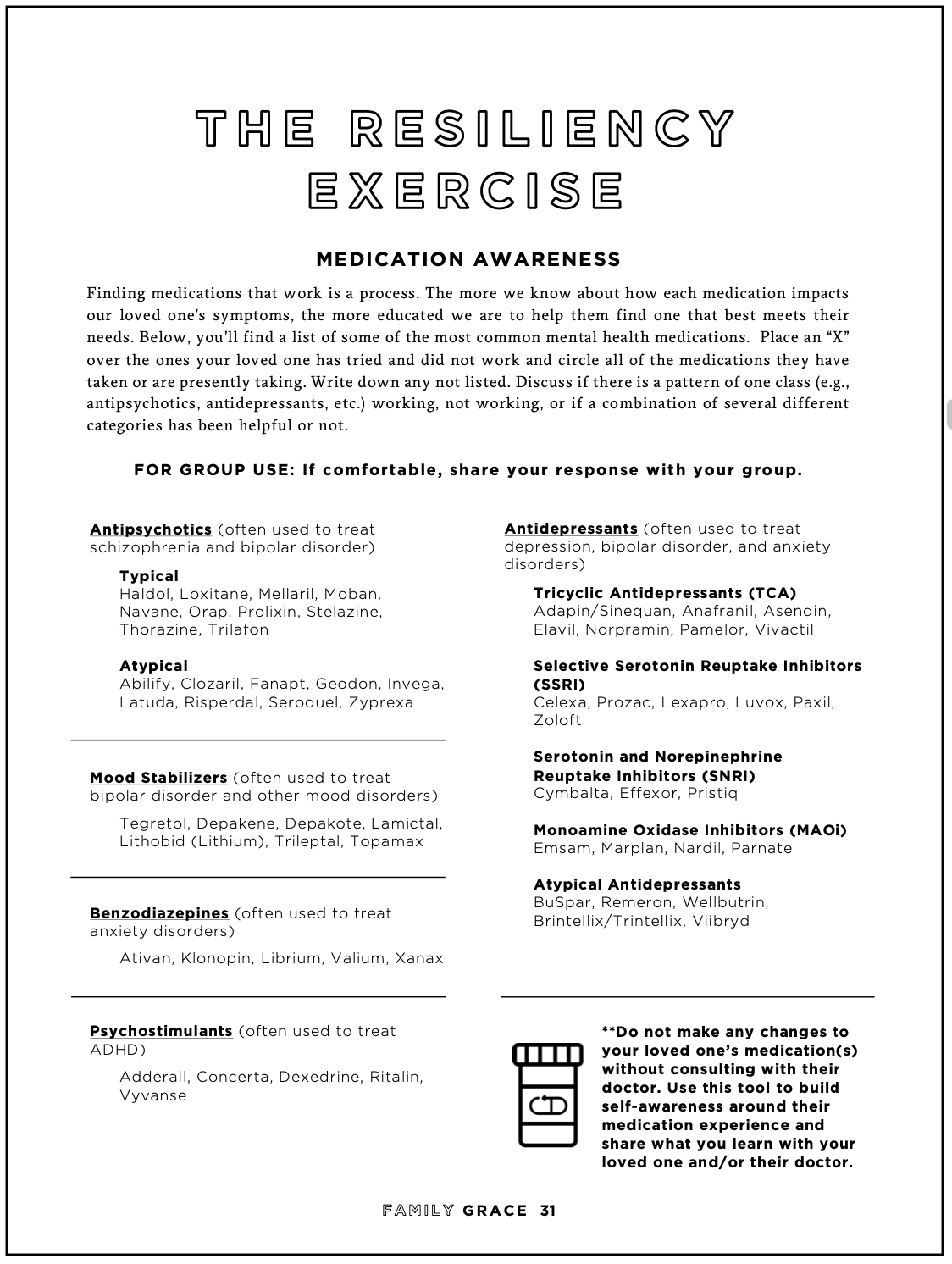
As pictured, our workbooks have helpful insights and tools for this process.
*Not perfect: Not all medications are the same or right (tailored) for everyone. For many, medications can make the mental health condition worse or bring adverse side effects that impair life. It is important to work with your doctor to understand how the medication is working and how tolerable it is. The last thing you want is to get “stuck” on a medication that you cannot tolerate, and that is impairing your life. It is normal for many individuals to try a few different medications until they find the right one and dosage.
(d) Medications may be lifelong or seasonal (no right or wrong to each). Everyone’s journey is different, and so is their medication need. For many, their medication is a lifelong journey that is part of their ongoing stability, and they live thriving/resilient lives (they do better on it than off it). Then, many others take medication for a duration of time (months to years), at some point, with their medical providers’ counsel and advice working together (psychiatrist, GP, and LPC/Therapists), they can successfully wean off and continue to thrive with a resilient life. I’ve seen both types, and both have amazing, beautiful, fruitful lives.
(e) Christian and Great Pros: You may find Christian doctors and psychiatrists who affirm your faith journey as part of the process.
*AND I also know a psychiatrist, who was not a Christian, but they cared just as much as the Good Samaritan story — and they were known as one of the best doctors in the city (I saw people have great outcomes from their care). God may and can guide you to their excellent care as well.
(f) Christian pastors/leaders are on meds: Many Christian leaders today have taken or regularly take psychiatric medications for their own mental health wellness and well-being. It’s part of why they are continuing, and even thriving in their ministry and personal lives.
Professional intervention is part of the faith journey, not excluding it — because God is a God in our weakness, not outside it.
Seeking medical and professional intervention requires just as much faith as any other area of life … because God is a God in our weakness … a power in our weakness … not far from you. He is there to see you through the process and journey (see 2 Cor. 12:9-10; John 17:26; Gal. 2:20; Eph. 2:6; Phil. 1:6).
What do you think? Leave a comment below!
Joe Padilla | Grace Alliance
This article is free. So is everything else we offer.
Help us keep everything free for individuals and churches who can't afford to pay.
*Note: At Grace Alliance, we are working with the opportunity to educate and equip the Church, not condemning or judging what they don't know. We find that church leaders are eager to learn, which reduces mental health stigma (changing the culture)! (1, 2)
(1) Anthony JS, Johnson A, Schafer J. African American clergy and depression: what they know; what they want to know. J Cult Divers. (2015) 22:118–26.
(2) Taghva, A., Noorbala, A. A., Khademi, M., Shahriari, A., Esfahani, M. N., Asadi, A., Mohsenifar, J., Yousefifard, A., Abolhassani, M., Bolhari, J., Hajebi, A., & Rahnejat, A. M. (2022). Clergy's Viewpoint Change Toward Mental Health and Stigma on Mental Illness: A Short Course Training. Frontiers in Psychiatry, 13, 864806.